
Loudline
from download to your own loudness app.
Loudline is an Android and iOS app that fixes quiet recordings: it measures a podcast, lecture or voice note, then exports a louder, cleaner copy with its measured LUFS and true peak. This guide takes you from the download to a branded build in the stores, step by step. Read it top to bottom the first time; after that, press / and search.
AI disclosure: AI tools were used to assist with parts of the code, documentation and graphics of this item. The author reviewed the result. The product itself contains no AI features.
01What you bought
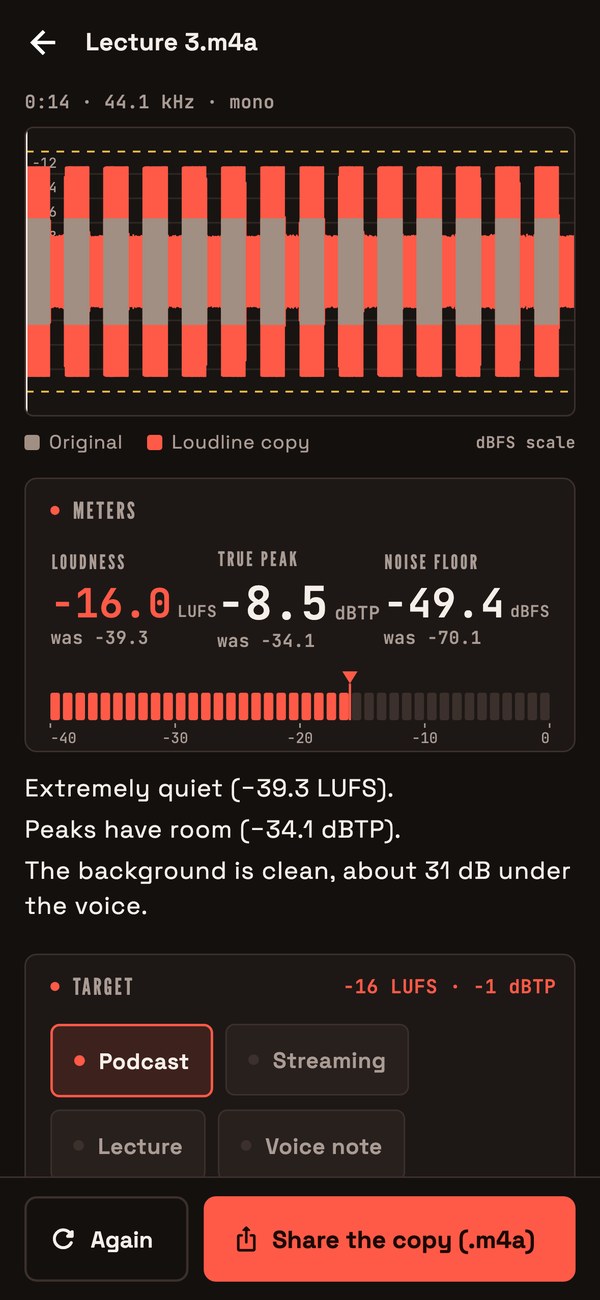
Loudline is a complete, white-label mobile app source code plus an optional small server. The user picks a quiet recording (a voice memo, a lecture, a WhatsApp voice note, or the audio of a video). The app measures it first: integrated loudness in LUFS, true peak and noise floor. Then it applies a loudness target, an optional tone preset, optional noise reduction and a look-ahead limiter at a true-peak ceiling, and exports a copy. The copy is measured again, and the app shows before and after on one waveform with instant A/B playback. The original file is never touched, and nothing is uploaded.
Loudline does not change the volume of the phone and cannot make a speaker louder. It fixes the recording itself, and it says so on its first screen. It does not promise a fixed gain: how much louder a copy gets depends on the file, and the app tells the user when a target could not be reached. Please describe your app the same way in your store listing.
| Part | Folder | What it is |
|---|---|---|
| Mobile app | app/ | Flutter project for Android and iOS. Works fully offline, with no server. |
| Server (optional) | server/ | Node.js backend with an operator console: change the paywall, limits without Pro, features, file limits and loudness presets, show announcements and force an update without a new build; optionally confirm purchases with the stores. |
| Contract | contract/CONTRACT.md | The three API calls between app and server, with example JSON. |
02Folder map
| Path | What is inside |
|---|---|
app/lib/brand.dart | App name, tagline, accent colour, fonts, support/privacy/terms links, default store product ids, server address, audio channel name. The one file for rebranding. |
app/lib/src/dsp/ | The audio code, written in Dart: loudness meter, true-peak meter, limiter, noise reduction, tone presets, WAV reading and writing, the render pipeline. See How the measuring and processing works. |
app/lib/src/ | Also core/ (config, limits, history, diagnosis texts), services/ (session, batch, A/B player, purchases, settings, config client, ping) and ui/screens/ (Onboarding, Home, Studio, Batch, Paywall, Settings, Update). |
app/android/ | Android project, with the Kotlin AudioCodec.kt (decode and AAC encode) and MainActivity.kt. |
app/ios/ | iOS project, with the Swift AudioBridge.swift (decode and AAC encode) and PrivacyInfo.xcprivacy. |
app/assets/fonts/ | League Gothic, Space Grotesk and JetBrains Mono fonts with their licence texts. |
app/tool/make_icon.py | Script that draws the app icon. |
app/test/ | Automated tests: loudness reference values, limiter, noise reduction, full render, config fallback, paywall, limits, batch and screens. |
server/src/ | TypeScript server: app.ts (routes), presets.ts, purchases/ (App Store and Google Play checks), admin/manifest.ts (what the console shows). |
server/packages/admin-kit/ | The operator console (MIKODES Admin Kit), licensed with this item. |
server/.env.example | Every server setting, with comments. |
server/Dockerfile | Container build for the server. |
03How it fits together
The app works alone. The server is optional: the app asks it for settings and presets, can report an opt-in count, and can send a purchase proof for checking. Arrows point from the part that calls to the part that answers.
04Quick start (about 20 minutes)
Flutter runs natively on Windows: use PowerShell for the flutter commands and Android builds (iOS builds need a Mac). For the server, either install Node.js 22.12+ for Windows and use PowerShell (replace cp .env.example .env with Copy-Item .env.example .env; there is no openssl by default, so use WSL or any random 64-character hex string), or run the commands in WSL 2 (Ubuntu) or Docker. macOS and Linux users can ignore this note.
- Install Flutter 3.41 or newer (the author used 3.41.4; see Requirements) and run
flutter doctoruntil it shows no red items for the platform you want. - Run the app. In a terminal:
Connect an Android phone with USB debugging on, or start an iOS simulator.cd app flutter pub get flutter test flutter run - Run the server (optional).
Opencd server cp .env.example .env openssl rand -hex 32 # paste the result after ADMIN_SECRET_KEY= in .env npm ci npm run build npm starthttp://localhost:8787/adminand follow First sign-in. - Rebrand. Follow Rename and rebrand: name, package id, bundle id, icon, colours.
- Create the store products and put their ids in the app or the console: Store products.
- Build and publish: Release builds and signing.
The codec bridges (Kotlin on Android, Swift on iOS) compile and are in the builds, but they have never run on a real device or a simulator. The first thing to do on a device: pick an .m4a file, an .mp3 file and a video, make a copy of each and share it. See First device test.
A read-only demo of the operator console: loudline-demo.mikodes.com/admin · Email: demo@loudline.demo · Password: loudline-demo-c72c5c-2026 (read-only demo account)